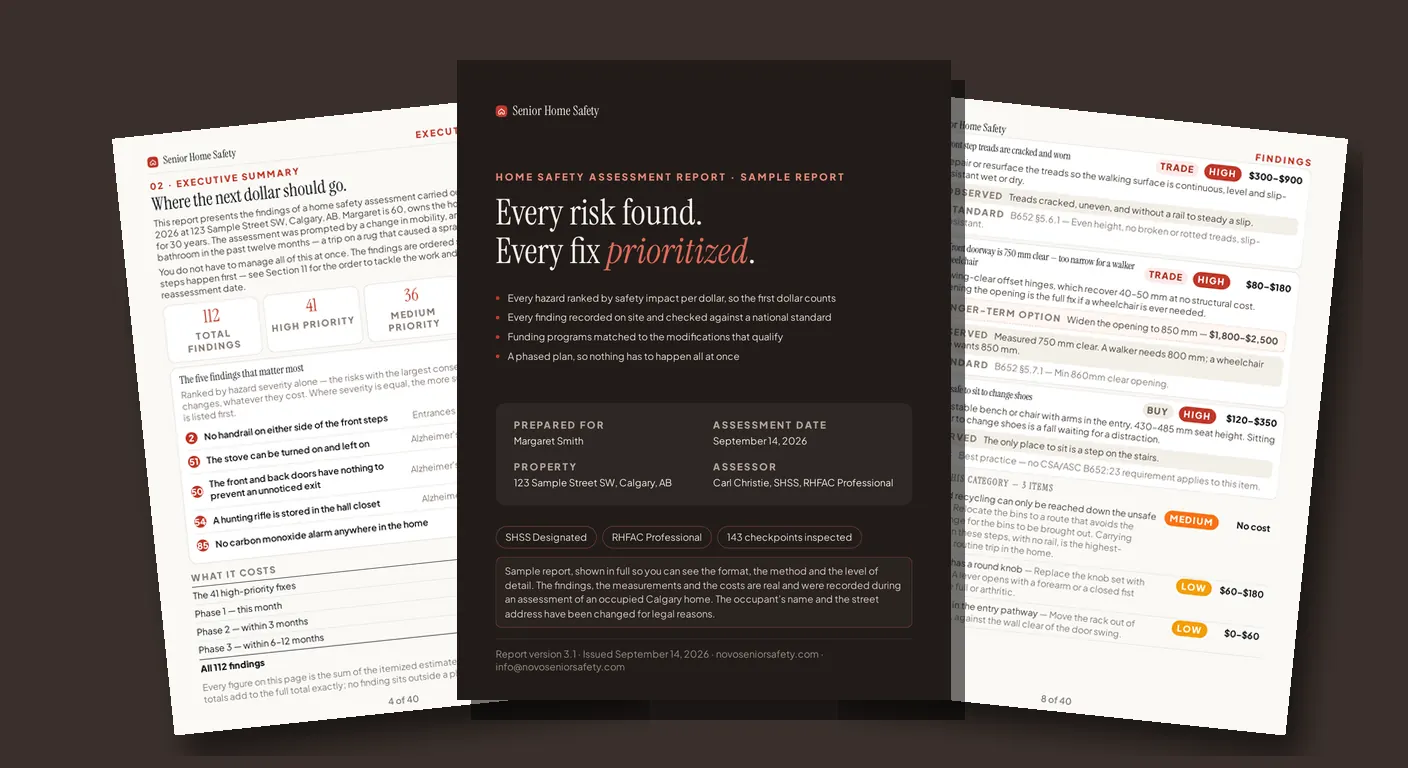
The sample at a glance
One house, fully assessed.
Ten of the 112 findings cost nothing at all to resolve. That ratio is typical rather than remarkable: a meaningful share of what makes a home unsafe is a rug, a cord, a stored item or an unlocked cupboard, and costs only the decision to deal with it.
The sample is a genuine assessment of a property belonging to Novo Industries Inc., published under a changed name and address. The findings and measurements are real; the identity is not. Contractor names appearing in it are placeholders, clearly labelled as such in the document.
Structure
How the report is laid out.
One-page summary
The whole assessment compressed to a page: how many findings, how many are urgent, what the first phase costs, and what to do this week. Written for the family member who will not read forty pages.
Scope and method
What was assessed, what was not, what equipment was used, and the limits of the exercise. Stated at the front rather than buried at the back.
Findings by category
Twelve sections, each working through its checkpoints. Every finding gets a priority, what was observed, the measurement where one applies, the recommended fix, a Calgary price, and a photograph where the finding is high priority.
Next Dollar Impact ranking
Every finding in the home, re-sorted into a single list by safety impact per dollar. This is the section most families use first.
Phased capital plan
Three phases — this month, within three months, within six to twelve months — with a cost total for each. Designed so a family can stop after phase one and still have removed most of the risk.
Funding notes
Programs that may apply, noted against the findings they relate to, with links to the official pages. Not an application and not a promise of eligibility.
Hiring the work out
A Calgary price for every fix, and what to check and ask for before any contractor starts — a $2M certificate of insurance and a WCB clearance letter.
Measurements and standards
The dimensional record, and the CSA/ASC B652:23 clause references that some findings draw on, kept as a quiet reference line so the finding itself stays in plain language.
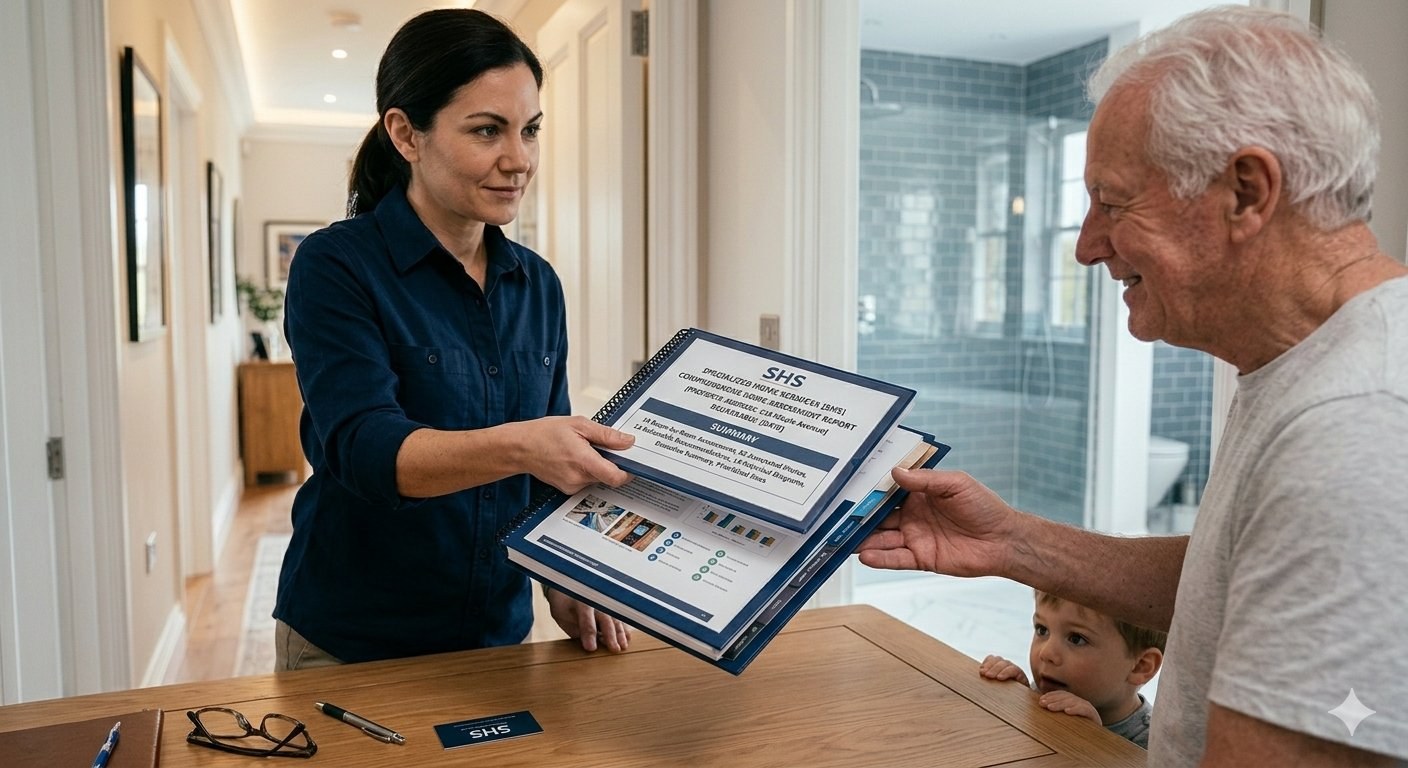
A finding, in full
Every finding follows the same shape.
So the report can be read straight through or dipped into. Priority, what was observed, the measurement where one applies, why it matters, the recommended fix, a Calgary price, and a photograph where the finding is high priority.
Photographs are deliberately not attached to every finding. A family should not receive an album of things in their home that are perfectly fine.
A finding, in full
What one line of the report looks like.
Every finding follows the same shape, so the report can be read straight through or dipped into. The elements are:
| Priority | High, medium or low, assigned by the ranking method rather than by feel |
| What was observed | Plain description, written for a family rather than a trade |
| Measurement | Where the finding has a dimension. Findings such as “no grab bar present” have none, and the report does not invent one |
| Why it matters | The mechanism — what would have to happen for this to cause an injury |
| Recommended fix | Specific enough for a contractor to quote from without a second visit |
| Cost range | A planning figure drawn from typical local pricing. Not a quote |
| Photograph | Included for high-priority findings. Deliberately not for every finding — a family should not receive an album of things in their home that are fine |
| Standard reference | Where one applies, a quiet CSA/ASC B652:23 clause line under the finding |
Limits
What the report will not tell you.
Cost figures are planning estimates built from typical local pricing, not quotes. Real quotes vary with access, materials and who is available. The report is prepared for you alone — a buyer, lender or contractor may not rely on it. It carries no opinion on the condition, structure, systems, value or insurability of the home, and it is not a medical, clinical or occupational therapy assessment of any person.
If something in a delivered report is factually wrong or incomplete, tell us within ten business days and it is corrected at no charge. Full terms: Terms of Service.